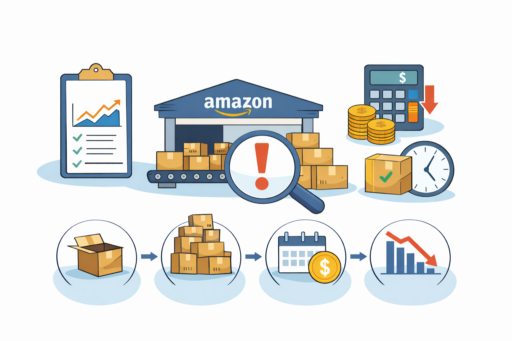
The Hidden Profit Lever Most Sellers Ignore
The Profit Killer You’re Probably Ignoring
If you’re selling on Amazon, your inventory isn’t just “stuff in a warehouse.” It’s your cash flow, your ranking, and—if you screw it up—your biggest nightmare.
Most sellers treat inventory like a chore. They reorder when the little red bar shows up on the dashboard, buy extra “just in case,” and cross their fingers that the boat from China arrives on time. That’s not a strategy; it’s gambling. And on Amazon, the house always wins through storage fees and lost rankings.
If you want to actually scale, you have to stop playing defense. Here’s how the top 1% of sellers actually handle their stock without losing their minds (or their margins).
In this guide, we’ll break down
- Why poor forecasting creates expensive problems
- The exact systems top sellers use to stay in control
- How to implement proven inventory strategies
- When it makes sense to outsource to experts like us
Why Amazon Inventory Management & Forecasting Matters
Inventory mistakes don’t always show up immediately but they always show up eventually.
Without accurate forecasting, sellers face five major issues
The “Stockout” Death Spiral (Running Out of Inventory)
Running out of stock isn’t just “missed sales today.” It’s a total reset.
PPC Becomes a Charity: You spent thousands on ads to get that #1 spot. Now, a competitor is sitting in your seat, and you’ll have to pay double to kick them out when you’re back in stock.
The Algorithm Forgets You: Amazon rewards consistency. When you hit zero, your ranking doesn’t just pause; it craters.
- Stockouts lead to lost revenue because you have no inventory available to convert demand into sales.
- They hurt your ranking and visibility since Amazon’s algorithm prioritizes consistently in-stock listings.
- They increase marketing inefficiency because your PPC spend can’t generate returns without inventory.
- They allow competitors to capture your market share, making recovery slower and more expensive.
The “Just in Case” Trap (Overstocking)
I get it. You’re scared of running out, so you buy six months of inventory. Don’t. * Dead Cash: That’s $50k sitting on a shelf that could have been spent on a new product launch or better ads.
- Overstocking ties up cash in unsold inventory, reducing your ability to reinvest in growth.
- It increases storage and FBA fees as products sit longer in Amazon warehouses.
- It raises the risk of aged or dead inventory that becomes harder to sell over time.
- It forces margin erosion through discounts and promotions needed to clear excess stock.
Forecasting: Stop Guessing, Start Math-ing
Forecasting sounds boring, but it’s just looking at the “why” behind your sales.
The 90-Day Rule: For most steady products, your last 90 days are your best crystal ball. Average them out, but account for the trend. If you’re growing 10% month-over-month, your order needs to reflect that future, not your past.
Historical Data: Look at last year, but ignore the “flukes.” If you went viral on TikTok for one day, don’t buy 5,000 units thinking it’ll happen again next Tuesday.
At its core Amazon inventory management & forecasting answers two key questions
- How much inventory should you order
- When should you reorder it
- The goal is balance
- Avoid running out
- Avoid overstocking
- Minimize fees
- Maximize cash flow
Proven Demand Forecasting Methods
Strong demand forecasting starts with one simple idea understanding how your products actually sell over time. Instead of guessing, you use real data and patterns to predict what will happen next. This allows you to plan inventory with confidence, avoid costly mistakes, and stay ahead of demand.
Here are the most effective and practical forecasting methods sellers use
1. Historical Sales Analysis
Your past sales data is your most valuable starting point. It shows you exactly how your product has performed and gives you a reliable baseline for future planning.
Focus on identifying patterns such as your daily and weekly sales velocity, how your sales are growing month over month, and how they compare year over year. It’s also important to understand how promotions or advertising have impacted your performance.
To make this data accurate, remove any irregularities like stockouts or one-time spikes. This helps you build a clean and realistic foundation for forecasting.
2. Moving Average Forecasting
If your product has steady demand, this is one of the simplest and most effective methods to use.
You calculate the average sales over the last 30 to 90 days to estimate future demand. This smooths out small fluctuations and gives you a stable number to work with.
This method works best for products that don’t experience major changes in demand and have consistent sales over time.
3. Trend Based Forecasting
Not all products stay the same. If your sales are growing or declining, your forecast needs to reflect that trend.
For example, if your product is increasing sales by 10 percent each month, your future projections should include that growth instead of assuming sales will stay flat.
This approach is especially useful for newer products or those in a scaling phase.
4. Seasonal Forecasting
Many Amazon products are heavily influenced by seasonality, and ignoring this can lead to major inventory mistakes.
Think about how demand changes throughout the year. Some products spike during the holidays, while others perform better in specific seasons like summer or back to school periods.
A strong approach is to use last year’s data as a reference point, then adjust it based on your current growth and market conditions. This helps you prepare early and avoid being understocked or overstocked during peak periods.
5. Promotional Forecasting
Promotions can significantly increase your sales, sometimes multiplying your normal demand.
When planning inventory, you need to account for the impact of deals, discounts, PPC campaigns, and any external traffic you’re driving.
A practical way to estimate this is by looking at past campaigns and measuring how much sales increased. For many sellers, promotions can drive anywhere from two to five times their normal sales volume.
By planning ahead for these spikes, you can fully capture the opportunity without risking stockouts.
When you combine these methods, you move from reactive inventory management to a proactive system. Instead of guessing what might happen, you’re using data to guide your decisions which leads to better planning, lower costs, and more consistent growth.
Core Inventory Management Techniques
Forecasting tells you what should happen, but inventory management systems are what help you act on that information effectively. Without the right processes in place, even the best forecast won’t prevent stockouts, overstocking, or unnecessary fees.
Here are the core techniques every Amazon seller should implement to stay in control of their inventory
1. Safety Stock Strategy
Safety stock is your protection against uncertainty. No matter how accurate your forecast is, real-world variables like supplier delays or sudden demand spikes can disrupt your plans.
By keeping a buffer of extra inventory, you reduce the risk of running out of stock during unexpected situations. This is especially important when dealing with long lead times or inconsistent supply chains.
A simple approach is to hold an additional 7 to 14 days of inventory based on your average sales. This works well for most sellers as a starting point.
A more advanced approach involves adjusting your safety stock based on how much your demand fluctuates and how reliable your lead times are. The more variability you have, the larger your buffer should be.
2. Reorder Point Calculation
Your reorder point is one of the most important numbers in your inventory system because it tells you exactly when to place your next order.
Instead of guessing, you use a simple formula that considers how fast you sell and how long it takes to restock. The formula is based on your daily sales, your total lead time, and your safety stock.
For example, if you sell 25 units per day, your lead time is 40 days, and you keep 300 units as safety stock, your reorder point would be 1300 units. This means that once your inventory drops to that level, it’s time to reorder.
Having this system in place helps you avoid last-minute decisions and reduces the risk of stockouts.
3. Lead Time Management
Lead time is one of the most underestimated factors in inventory planning, yet it’s one of the main reasons sellers run out of stock.
It includes every step in the process, from production and freight to customs clearance and Amazon receiving your inventory.
To manage this effectively, you need to track both your average lead times and worst-case scenarios. Delays happen, so building a buffer into your planning is essential.
Regularly updating your lead time data ensures your forecasts and reorder points remain accurate as conditions change.
4. Inventory Turnover Optimization
Inventory turnover measures how quickly you sell through your stock, and it plays a major role in your profitability.
When your turnover is high, you’re selling efficiently, freeing up cash, and minimizing storage costs. When it’s low, inventory sits longer, increasing fees and tying up capital.
To improve turnover, you can adjust your pricing strategy, run targeted promotions to increase demand, and optimize your listings to improve conversion rates.
The goal is to keep inventory moving at a healthy pace without creating stock shortages.
5. Seasonal Planning
Seasonality can have a major impact on your inventory performance, and failing to plan for it can lead to missed opportunities or costly mistakes.
Some products experience sharp increases in demand during specific times of the year, such as holidays, summer months, or back-to-school periods.
To stay ahead, you should identify your peak seasons early, place orders well in advance, and increase your safety stock to handle higher demand. During these periods, it’s also important to monitor your inventory more frequently, ideally on a weekly basis, so you can react quickly if needed.
When these techniques are combined, they create a structured system that allows you to manage inventory proactively instead of reactively. This not only reduces risk but also improves efficiency, lowers costs, and supports long-term growth.