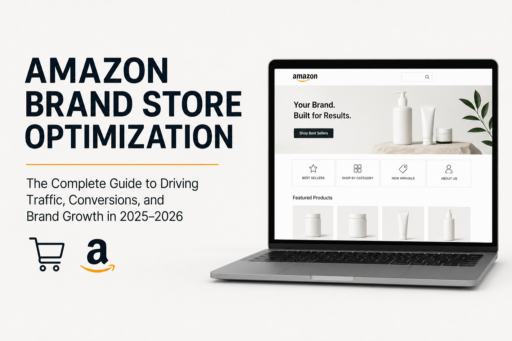
Amazon Brand Store optimization is the process of structuring, designing, and continuously improving your Storefront to increase traffic, engagement, and conversion rates. In 2025–2026, top-performing brands focus on conversion-driven UX, keyword-indexed Store pages, cross-channel traffic attribution, and data-backed merchandising strategies to maximize ROI from both organic and paid traffic.
The Ultimate Guide to Amazon Brand Store Optimization
If you’re treating your Amazon Brand Store like a static brochure, you’re leaving serious revenue on the table.
In 2025–2026, Amazon has evolved into a full-funnel ecosystem, and your Brand Store is no longer optional, it’s a core conversion engine. High-performing brands use their Storefront as a landing page for:
- Sponsored Brands traffic
- DSP campaigns
- External traffic (Meta, Google, TikTok)
- Influencer and affiliate funnels
This guide breaks down advanced, agency-level strategies to optimize your Amazon Brand Store for both ranking and revenue.
Why Amazon Brand Store Optimization Matters More Than Ever
Amazon’s algorithm (A10 + retail signals + engagement metrics) increasingly rewards:
- Higher session duration
- Multi-page browsing behavior
- Brand affinity signals
- Conversion rate improvements from branded traffic
Your Store directly impacts all of these.
Key benefits of a well-optimized Store:
- Higher ROAS on Sponsored Brands
- Better DSP retargeting performance
- Increased average order value (AOV)
- Stronger brand defensibility vs competitors
- Improved organic ranking via behavioral signals
Understanding Customer Intent Inside Your Store
When users land on your Brand Store, they typically fall into one of three intents:
1. Discovery
“I’ve heard of this brand, what do they offer?”
2. Comparison
“Which product from this brand is right for me?”
3. Purchase
“I’m ready to buy—show me the best option.”
Your Store must guide all three.
Core Elements of a High-Converting Amazon Brand Store
1. Strategic Store Architecture (Not Just Pages)
Most brands structure Stores by product categories. That’s outdated.
Top-performing brands structure by customer journey and use case.
Example (Supplements Brand):
Instead of:
- Vitamins
- Protein
- Energy
Use:
- Immunity Support
- Daily Wellness
- Performance & Recovery
This aligns with search intent and decision-making behavior, not internal catalog logic.
2. Keyword Optimization Inside Your Store (Underrated Ranking Lever)
Many sellers don’t realize this: Amazon indexes Store page text.
Where to include keywords:
- Page names (URLs)
- Section headers
- Image alt text (when possible)
- Text modules
Pro tip:
Create dedicated subpages targeting specific keyword clusters, e.g.:
- “Best Collagen for Skin”
- “Protein for Weight Loss”
- “Vitamins for Women”
This allows your Store to function like an SEO hub within Amazon.
3. Conversion-Driven Design (UX > Aesthetics)
Most Stores look good. Few convert.
High-performing Store design includes:
Above-the-fold clarity:
- Clear value proposition
- Hero banner with benefit-driven messaging
- Immediate CTA (“Shop Best Sellers”)
Scroll psychology:
- Problem → Solution → Proof → Products
Modular structure:
- Use alternating sections:
- Lifestyle imagery
- Product grids
- Benefit callouts
- Comparison charts
4. Product Merchandising Strategy
Don’t just list products—guide decisions.
Best practices:
- Feature Best Sellers first
- Use bundles to increase AOV
- Highlight high-margin SKUs
- Group products by:
- Use case
- Customer type
- Price tier
Example:
Instead of:
“Shop All Products”
Use:
- “Starter Kits”
- “Most Popular”
- “Advanced Users”
5. Sponsored Brands + Store Synergy
Your Store is only as powerful as the traffic you send to it.
Advanced Sponsored Brands strategy:
- Send traffic to specific Store pages, not homepage
- Align ad messaging with Store content
- Test headline → Store conversion rate
Example:
Ad headline:
“Best Supplements for Immunity”
Landing page:
Immunity-focused Store page with:
- Benefits
- Ingredients
- Products
This alignment dramatically improves conversion rate and ROAS.
6. External Traffic Integration (2025 Game-Changer)
Amazon is heavily rewarding brands that bring in external traffic.
Your Store should be your primary landing page for:
- Meta ads
- Google Ads
- TikTok campaigns
- Influencer links
Why not PDPs?
Stores:
- Load faster for browsing
- Encourage multi-product discovery
- Improve brand perception
- Increase AOV
Pro strategy:
Use Amazon Attribution + Store insights to track:
- Page visits
- Sales per page
- Conversion rate by traffic source
7. Data-Driven Optimization (Where Most Brands Fail)
Amazon provides Store insights—but few brands actually use them.
Key metrics to track:
- Page views
- Unique visitors
- Sales per visitor
- Top-performing pages
- Drop-off points
Optimization loop:
- Identify high-traffic, low-conversion pages
- Improve messaging and layout
- Test different product placements
- Adjust traffic sources
8. A/B Testing Your Store (Advanced Strategy)
While Amazon doesn’t offer native Store A/B testing, top agencies simulate it by:
- Rotating creatives monthly
- Testing different page structures
- Comparing performance via time-based cohorts
Test variables:
- Hero images
- Product order
- CTA language
- Page structure
9. Brand Storytelling That Converts (Not Just Looks Pretty)
Your Store should answer:
Why should I trust this brand?
Include:
- Founder story (brief, impactful)
- Brand mission
- Social proof (awards, certifications)
- UGC-style imagery
Important:
Avoid fluff. Focus on decision-driving credibility.
10. Mobile-First Optimization (Critical in 2026)
Over 70% of Amazon traffic is mobile.
Optimize for:
- Vertical scrolling
- Minimal text blocks
- Tap-friendly navigation
- Fast-loading visuals
Common Amazon Brand Store Mistakes (That Kill Performance)
- Treating Store as a static asset
- Sending all traffic to homepage
- No keyword optimization
- Overcrowded design
- No clear product hierarchy
- Ignoring analytics
- No alignment with ads
Real-World Example (Simplified)
Before optimization:
- Generic homepage
- All products listed randomly
- Low conversion rate
After optimization:
- Use-case-based pages
- Best sellers highlighted
- Traffic segmented by intent
- Conversion rate increased by 35%+
- AOV increased by 20%
How Pirawna Approaches Amazon Brand Store Optimization
At Pirawna, we don’t just “design” Stores—we build conversion systems.
Our approach includes:
- Deep keyword and intent research
- Store architecture strategy
- Conversion-focused design
- PPC + Store alignment
- External traffic funnel integration
- Ongoing performance optimization
We integrate your Store with:
- Amazon SEO
- PPC campaigns
- DSP strategies
- Inventory planning
Because your Store doesn’t exist in a vacuum—it’s part of your entire growth engine.
FAQ: Amazon Brand Store Optimization
1. Does an Amazon Brand Store help SEO?
Yes. While it doesn’t directly rank like product listings, it improves engagement signals, which influence organic rankings and conversion rates.
2. Should I send ads to my Store or product pages?
In most cases, Store pages perform better for cold and mid-funnel traffic, while PDPs are better for high-intent buyers.
3. How often should I update my Store?
Top brands refresh their Store every 4–8 weeks based on performance data and campaigns.
4. Can Amazon Stores be indexed by Google?
Yes. Store URLs can appear in Google search results, especially for branded queries.
5. What’s the ideal number of pages in a Store?
There’s no fixed number, but most high-performing Stores have 5–15 strategically structured pages.
6. How do I measure Store performance?
Use:
- Amazon Store Insights
- Amazon Attribution
- Ad performance data
7. Is a Brand Store worth it for smaller sellers?
Yes—especially if you’re running ads. It significantly improves conversion rates and brand perception.
Final Thoughts: Your Store Is Your Competitive Moat
In 2025–2026, winning on Amazon isn’t just about ranking products.
It’s about building a brand ecosystem.
Your Brand Store is:
- Your homepage
- Your funnel
- Your conversion engine
And if it’s not optimized, you’re leaking revenue from every traffic source.
Ready to Turn Your Amazon Store Into a Revenue Engine?
If you want to:
- Increase conversion rates
- Improve ROAS across ads
- Build a scalable brand presence on Amazon
Pirawna can help.
👉 Book a consultation today and we’ll audit your Brand Store and show you exactly where you’re losing revenue—and how to fix it.